Passage 1: On Endings (and the body’s first response to change)
The body often knows before we do.
An email lands, a conversation shifts, a familiar rhythm we've relied on starts to fray. And even before we name it as an ending, something in us has already registered the change, signaling that we've stepped out of accustomed territory and into the unknown. Sleep patterns break. Appetite loses its usual shape. There's a hum of vigilance just under the skin.
Light
Dark
When we notice these deviations from our norms, it's tempting to bypass the signals and look for an external "fix" or remedy. Something for the insomnia, the indigestion, the restlessness. But the internal beacon has already indicated that we're on a new path—the path of transition.
If you read the introduction to this series, you know I'm not speaking about endings in the abstract. I'm walking through one now. Something that once felt steady in my life is not what it was. And it's been striking how clearly my body has narrated that shift—a background buzz of tension, a sense of bracing, a kind of internal "no more" that I could feel long before I could explain it. With it came a subtle unmooring—a soft but insistent chorus of questions: Who am I without this thing that's ending? How will I recognize myself without it? Who am I becoming on the other side of this?
"No more" has been a turning point in my life before.
Decades ago, I felt it in hospital rooms with my late husband, listening as he was spoken of as a diagnosis rather than a person—as if a code in a chart could replace his story, and as if everyone with that label ("glioblastoma multiforme" or GBM) should follow the same script. My whole system said no more. No more collapsing a human into a category. No more reducing an individual to just their diagnosis. No more erasing the timeline, the context, the person. That embodied refusal is part of what led me into my current understanding of health and humanity, insisting that everything is connected, that we are all unique, and that all things matter.
This current "no more" is less visible from the outside, but the feeling in my internal ecosystem is familiar. It's the same whole-body truth-telling—the same insistence on alignment and recognition that I've entered a transition. I can't unsee what is now evident or pretend I'm still walking the old, well-marked path. And I share this to affirm that I'm not standing on the shore giving instructions about endings as your all-knowing guide. I've been tossed into the waters with you. As we talk about endings in this first passage, you might notice how your own body has been trying to tell the truth about what's changing in your life, and where you, too, have already entered a liminal space.
“Change is an event but a transition is the process that you go through in response to the change.”
Naming the anatomy: why start with endings
If we're going to talk about the anatomy of a transition, we need a way of seeing its shape. That's where I'll borrow from the work of William Bridges for this passage.
Bridges was an educator and consultant writing in the early 1990s, watching organizations roll out carefully planned changes—new structures, new strategies, new systems—while the people inside those systems quietly fell apart. His Transition Model was a way of naming that gap: the difference between managing the logistics of change and tending to the inner experience of it. Since the ‘90s, his framework has been used in leadership development, counseling, education, and other settings where what matters isn’t just rolling out change, but shepherding people through the inner passage it creates—supporting them to live through significant shifts rather than simply comply with them.
Bridges made a straightforward but powerful distinction: Change happens on the outside. Transition occurs on the inside.
Change is the diagnosis, the move, the breakup, the new role, the loss. Transition is the part you carry in your body and your story—the grief, the confusion, the reorienting, the shift in identity, alignment, or grounding, the slow knitting-together of a different life.
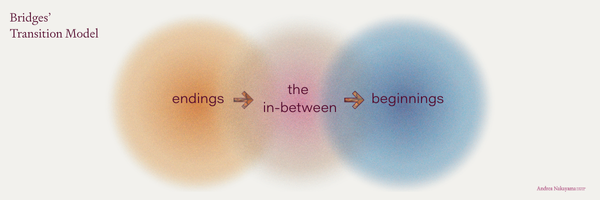
Bridges described transition as having three phases:
Endings
The Neutral Zone (the in-between)
New Beginnings
On paper, that can look tidy. In real life, it's anything but linear. We can be in more than one phase at once. We can circle back. We can feel a beginning in one part of our life even as another is ending. But as a rough map, it helps. It gives us language for what so many of us are living: something is ending, the middle feels strange and unsteady, and we can't yet see the new shape of things to come.
I'm choosing to start this series where Bridges starts—with endings. Not because endings are more important than beginnings, but because they're the part we're most likely to minimize or rush past. We're encouraged to "focus on the positive," to move on, to reinvent. And yet the nervous system doesn't work that way. It needs time to register what's been lost, what's dissolved, what is genuinely no longer. If we skip that acknowledgment, the unfinished ending tends to trail us into whatever comes next.
“With an ending, we don’t just start anew. Instead, we enter the in-between.”
Endings are not only about death or dramatic rupture. They can be quiet—a role slowly losing its fit, an institutional belief you can no longer inhabit, a story about who you're supposed to be that no longer feels true, a rhythm that once felt supportive and now feels thin or constricting. Sometimes nothing tangible changes at first, but inside, something has already said “no more.”
Bridges' language helps us honor that moment. Instead of telling ourselves to be grateful, to stop overreacting, to push through, to be "ok," or to suppress the internal grumble, we can say: "Oh. I'm in an ending."
It's not a judgment (of self or even other), but a deep recognition of the inner landscape. From there, we can start to ask different questions: What exactly is ending? What am I being asked to release? What part of me is trying to hold on?
For the rest of this week's passage, we'll stay here—at the threshold of endings and the entry to the liminal space. We'll look at what this phase can do to the body, how it can shake our sense of who we are or what we believe in, and how we might move through it with a little more honesty and a little less self-blame, before we ever ask ourselves to step into what's next.
The physiology of loss and disorientation
Bridges gave us language for the inner landscape of endings and the recognition of the in-between. He reminded us that if we skip over endings in our haste to get to what's new or "next," the unresolved pieces don't disappear—they simply trail us into the next chapter. Functional Nutrition invites us to look under the hood and see what those endings ask of our body.
When something ends—whether or not we've fully admitted it to ourselves—our biology tends to register it as a threat to stability. The nervous system is wired to love the familiar, even when the familiar isn't ideal. So when a role, relationship, belief, way of life, or structure dissolves, the body often responds as though the ground itself has shifted.
In practical terms, that can look like:
Stress chemistry on a low simmer. Cortisol and adrenaline are the hormones that help us mobilize in the face of change. During an ending, they often run a little higher, a little longer. This slow burn can make it harder to fall asleep or stay asleep, easier to snap or cry, and more difficult to access the kind of calm focus we expect of ourselves. We may find ourselves more irritable or moody, reacting sharply to small things or to people we care about, and then feeling confused or ashamed afterward. Those responses aren’t character flaws—they’re what a taxed nervous system looks like from the inside.
Autonomic tug-of-war. The "fight–flight–freeze" branch of the autonomic nervous system (often called the sympathetic branch, though 'freeze' has its own complexity) may hover closer to the surface. Heart rate and breathing run just a bit higher than usual, even at rest. There's a sense of bracing—waiting for the next piece of news, the next conversation, the next shoe to drop. Even if nothing dramatic is happening on the outside, the inner system is on alert. It’s your fight-or-flight response trying to protect you, not evidence that you’re overreacting.
Shifts in appetite and digestion. For some, endings shut appetite down. For others, they crank up cravings for stamina—sugar, refined carbs, caffeine. The gut is intricately wired to the brain, and it doesn't love uncertainty. Motility can change (constipation for some, loose stools for others). That "bolus in the chest" feeling I mentioned in an earlier post is one way the digestive system speaks when it's carrying what hasn't yet been emotionally processed.
Unsteady rhythms. The internal clocks that regulate sleep, wakefulness, and energy (our circadian rhythm) are sensitive to stress and to changes in routine. With an ending, our usual anchors—when we wake, how we move through the day, when and how we eat—may get disrupted. The body then has to work harder to find its bearings, which can feel like fatigue, brain fog, or being "wired and tired" at the same time.
None of this means you're doing something wrong.
This is what a human body in transition often looks like.
When Bridges writes about endings, we might imagine something emotional or abstract. But endings are also intensely physical. They live in our hormones, our pulse, our gut, our sleep, our capacity to focus, connect, and respond. Endings deserve to be held and cradled with the utmost care, which is precisely what Bridges was pointing to: a pause long enough to name what has been lost, to grieve it, and to tend to the people living through it (including ourselves) before we rush toward whatever is "new" or "next."
When leadership asks us to march forward as if nothing has really changed, Bridges might say they're managing change but skipping transition. And when you ask the same of yourself—demanding that you “bounce back,” “stay positive,” or “just get on with it”—you’re doing something similar inside your own skin: hurrying the timeline while your tissues are still trying to catch up.
In Functional Nutrition, we might say that this phase increases your load—the total burden your body is holding from stress, inflammation, unfinished repairs, and all the small and large demands of your days. When that load goes up, whatever was already a little vulnerable (your digestion, your sleep, your blood sugar, your migraines, your autoimmune symptoms) may speak up more loudly. That doesn't mean the ending "caused" those things. It means the system has less capacity to buffer them. And because transitions don’t run on a clear schedule, your body may be carrying that extra load longer than you’d like, which is all the more reason to meet it with patience rather than pressure.
I offer this not as another reason to worry, but to lift some of the blame off you and your body. When something is brewing just below the surface—your sleep shifting, your digestion going off script, your fuse feeling shorter than usual—it may simply mean your system is carrying more than it can comfortably absorb, not that you've failed, backslid, or been betrayed by your body. This is physiology: your body trying, in its own way, to keep you safe in unfamiliar territory.
As we stay with endings in this passage, you might begin to notice:
Where does my body seem to be carrying this ending?
What's different in my rhythms, my appetite, my tension, my energy?
How have I shown up in ways that tell me that I am, indeed, carrying a heavier load than usual?
I’m asking those questions of myself, too.
Right now, my body is carrying more than one ending. One of them is hard to name in public—a shift in identity that has altered my place in a world I helped build. My jaw knows all the endings. So does my sleep, my digestion, the way my shoulders rise toward my ears when my calendar or inbox asks me to pretend nothing has changed. I haven’t been able to plan ahead, to think about the upcoming holidays. I’ve spent my time trying to make sense of something that, to my nervous system, makes no sense. As you read, know that while I may talk about some more palatable endings through this passage, I’m also walking through the darker kind—the kind that doesn’t yet have clean language or ceremony.
We’ll keep returning to the questions I’ve posed above, not to pathologize our experiences, but to gently map the real, lived anatomy of this phase of a transition: endings.
The grief that doesn't even look like grief
Not every ending comes with a eulogy.
Some arrive as a plane ticket, a packed suitcase, a new address in a different time zone. The people we love are still very much alive, but the way we've known them, the way we've known ourselves in relation to them, is changing.
When my son Gilbert first started spending long stretches away—camps, then college, then New York as a college grad, then that initial season in Seoul and Tokyo—I felt it mainly as a disturbance in the field. Fewer footsteps on the stairs. Fewer half-finished cups on the kitchen counter. No music coming from the downstairs upright piano. A silence that sounded different from the quiet I'd often savored, or grown used to in the two-story house we inhabited—each of us with our own tempo, sometimes intersecting in shared jokes, conversations, cooking or meals, sometimes more like parallel play under the same roof.
Certainly, nothing catastrophic was happening. These shifts were the good kind of story: a young adult following his curiosity, building a life, finding his way. All things I’m proud of. And yet my body initially registered his next step, a move to a far away country, as a disruption.
After his return to New York from his first stint in Asia, outside a small dashi shop in Brooklyn (I was visiting from Portland, OR; he was re-acclimating before moving into his new apartment in Manhattan), he told me—almost offhandedly—of his plans to move back to Tokyo. "Maybe for a few years…?"
I heard myself answer, laughing but not really joking, almost whining: "It's so far away…."
But before my nervous system had time to spin its full tale of abandonment, distance and loss, he cut in: "You're going to love it."
He began describing the food, the clothes, the architecture he wanted me to see, speaking with a measured excitement that told me he knew me well. And that he was eager to share it all… with me. In that moment, something inside me unclenched. Immediately, my body exhaled and calmed. My cousin's words from months earlier finally landed: At 23, it was true that he no longer needed me. But he was choosing me.
That relief didn't erase the grief of his relocation—the fact that his life was taking root an ocean away. (He's back in Tokyo now). It just helped me recognize the shape of that grief: not a fear that I was losing my son or that something in my parenting propelled his leaving, but a quieter ache. An ache that a certain way of being his parent was ending—the daily proximity, the small decisions, the built-in place in his every day, even the comfort of knowing he was still just a same-day nonstop flight away. Naming it that way made it easier to recognize the ending and make room for this new and unknown passageway.
For me, this was one of those paradoxes of endings. Nothing about it looked like an ending from the outside. A child grows up and moves away. A partner's attention turns toward a demanding job or an aging parent. A beloved role in a company or community shifts or disappears. No one around us calls it "loss." But the body does. There's a soreness where there used to be a daily touchpoint. A tenderness when we pass the places that once held us together. A sudden wave of tears in the bulk tea section of the co-op, for no apparent reason.
In Bridges' language, these are endings too. Not because the relationship is over, but because a particular form of it is.
The version of you who woke up every day with a kid down the hall. The part of you who was always reachable, always responsible, always the one holding the thread—the person who got called to help solve the problem, make the decision, steady the ship. That identity is shifting. And the nervous system feels unmoored—even when our rational mind is busy reciting how "lucky" we are that our loved ones are healthy and thriving, or that this feeling of discomfort will come to an end, or that what's next will (most certainly) be great.
Grief in the early phase of an ending can be confusing because it doesn't always match the facts on the ground. You can feel proud and lonely at the same time. Relieved and bereft. Expanded and oddly hollow. Right and even wrong.
Part of what I'm learning, as Gilbert's orbit widens and my own life changes shape, is that this both/and is not a mistake in the system. It is the system. Love and loss are braided together. Every time we allow ourselves to love and honor and appreciate and belong and build, we're quietly agreeing to a future we can't yet see—one where that form of connection will eventually change.
So if, in the midst of your own transition, you find yourself grieving something that "shouldn't" hurt—your kid's new apartment across the country, a boss's retirement, a role you outgrew, a system that no longer serves, a period that stops arriving, a rhythm that no longer fits, a status that needs to shift—you're not being ungrateful or dramatic. You're registering an ending. Your body is telling the truth about a change, before the rest of you has language for it.
For now, we'll allow ourselves to stay right here: with that ache, with confusion, with the odd mixture of love and loss. Before we talk about what might be beginning, we're letting the ending be an ending—even, and especially, if no one else can seem to name it that way.
An invitation to notice an ending
Pause here and let the thought of endings move closer to your own life.
You don't have to name any transition out loud yet. You don't even have to be sure what's ending. Just start with your body.
Step 1: A brief check-in
You might close your eyes, or soften your gaze, and take one fuller breath.
Then, slowly:
- Notice your jaw and throat. Any clenching, holding, or words that are on the tip of your tongue but have not been said?
- Notice your chest. Tight, heavy, stuck, hollow, spacious, thumping?
- Notice your belly. Settled, fluttery, rumbling, knotted, numb?
- Notice your shoulders and the back of your neck. Braced? Tired? Strangely light?
- Notice your hands. Restless? Still? Wanting to reach for something or someone?
There's no "right" way here. In fact, there's no right way for an ending to feel.
You're just taking attendance: Who's here? What's active? What's quiet?
If it helps, you might also glance at your daily rhythms:
- Has your sleep shifted lately, even slightly?
- Is your appetite different from "before"?
- Is there a place in your body that feels more tender, more reactive, or more shut down right now?
What we're inviting is Bridges' model made real—the endings phase as it lives in your nervous system, your hormones, your gut, your breath.
Step 2: A few lines on paper
If it feels safe enough, give an ending (or almost-ending) a few minutes of writing or drawing time.
You could start with one of these prompts:
- Lately, my body has been saying "no more" when…
- The first hint that something was ending showed up in my…
- If this ending had a place in my body, it would live in my…, and it would sound like…
Be as specific as you are able.
Maybe it's the 3:30 a.m. waking, like I've been experiencing these past couple of months—an internal surveillance, as if some part of me has taken the pre-dawn shift and won't go off duty. Or maybe it's subtler: your heart rate pulsing a little faster than usual, the blood pressure cuff at your check-up creeping up a few points, the sense that your body is idling higher even when you are "just sitting there."
When the body isn't entirely convinced you're safe, it shifts into protection mode: more muscle tension, more watchfulness in the nervous system. And, for many of us, more noise from the immune system. Old rashes, joint pain, gut symptoms, autoimmune or mast cell flares can resurface—not because you haven't followed some protocol or set of rules to the T, but because your system is trying to fortify itself around an ending it doesn't yet understand.
For you, it might be something entirely different from what I've described: the way your shoulders never quite drop, leading to a literal pain in the neck. The way your blood sugars are, all of a sudden, spiking or swinging. The way you can't make yourself answer an email or return a call that used to feel easy.
As you scan through your body, remember that we're not trying to fix anything or make a plan. We're simply mapping the anatomy of an ending as it moves through you—your physiology, your story, your particular life.
“Endings rarely disappear just because we look away. They tend to wait for us, patiently, until we’re ready to listen.”
If nothing comes, that's information too. You can always come back to these questions and prompts at another time. Endings rarely disappear just because we look away. They tend to wait for us, patiently, until we're ready to listen. And if nothing is ending in your life right now, right on. You've likely walked through endings before, and you will again.
Endings are inevitable.
Creating room in the body for an ending
As we've seen, we can't always choose our endings. A friendship that once felt like home grows uncomfortable. A work rhythm that used to fit begins to chafe. An institution we’ve trusted no longer feels like a place we can count on. Something or someone we love takes its own trajectory, and we don't get to conclude things as we had hoped or envisioned.
But we do have some say in how we hold our own response.
So much of the suffering in the ending phase comes from thinking I shouldn't be reacting like this. I shouldn't be this tired, this distracted, this emotional, this angry. I shouldn't still be thinking about it. I shouldn't need so much… [fill in the blank].
From a Functional Nutrition lens, I see endings as moments when the body is doing exactly what it was designed to do: protect us in unfamiliar territory. The nervous system is scanning for safety. The endocrine system is adjusting chemistry to help us mobilize. Digestion, immunity, and energy are trying to make sense of a new landscape.
The problem isn't that we're "too sensitive." It's that we're rarely taught how to live inside a body that's telling us the truth—its truth.
What if we make more room for that truth, rather than shutting it down?
1. Put your symptoms in context
When you notice the odd waking, the chest tension, the headache, the flare of an old symptom, the unusual reaction, you might experiment with sitting with one simple sentiment that acknowledges where you are:
Of course my body is responding this way. Something is ending.
You don't even have to know the full shape of the ending yet.
You're just gently connecting the dots between what Bridges identified as the "endings" phase and how it's showing up in your tissues, your hormones, and your sleep.
Context doesn't magically make the discomfort go away. But it often softens the second layer of suffering: the story that you're failing, that you're wrong for what you're feeling (or how you're behaving), or that you're "back at square one." You're not. You're in an ending. Endings can be rough.
2. Reduce the load where you can
Again, endings usually arrive on top of everything else you're already holding and managing—that load that I mentioned earlier. The world doesn't stop for the ending and you often have not prepared for it in this form. There's still work, emails, family, bills, and world news. In fact the ending might lead to more to-do’s for a variety of reasons.
First, let's take a moment to recognize that.
Then let's acknowledge this: you don't need a complete health overhaul right now. This is not the moment for an extreme diet, a 30-day challenge, a full life redesign, a battery of new tests, or the perfect prescription. When you're already carrying more, adding more rules or interventions rarely creates relief. It, too, can often add to the load.
What the body usually needs in an ending is not discipline, but room—a bit more space to process what's happening. Some more kindness in how we move through the day.
“What the body needs in an ending isn’t discipline, but space.”
That might look like:
- Making food simpler for a while: repeating a few easy, grounding and nourishing meals instead of striving for variety or perfection.
- Protecting one anchor for your nervous system—ten minutes outside in daylight, a consistent wake time, a short walk after a meal, or whatever you know is nourishing for your system.
- Saying no (or "not this month") to one non-essential commitment, so your system has a bit more room to process what's ending.
Think of it as clearing a small patch of ground so the body has somewhere to set down what it's carrying, even briefly.
We're not trying to earn our way out of the ending by being "better" patients or more compliant humans. We're asking a different kind of question: What would it mean to support the body that is carrying this ending?
For some, that might mean paying attention to blood sugar—remembering that long stretches without food can amplify anxiety, irritability, and that uber early morning wake-and-worry. For others, it might mean tending to digestion—making meals that are easier to break down, so the gut isn't doing heavy lifting while the rest of you is already stretched thin. For many of us, it means finding tiny ways to signal safety: a slower exhale, a warm drink in both hands, stepping outside to feel actual ground under your feet, finding the place to speak your truth.
None of this cancels the grief or confusion. It just means you're not asking your physiology to white-knuckle its way through an ending alone.
As we stay with this phase—the anatomy of endings, in the body and in story—remember that you don't have to do it perfectly. You don't have to optimize this. The invitation is much simpler: to notice what's happening inside you, to give it a little more margin, and to let your baseline care for your body be part of how you move through this and coming passages.
3. Offer your body a cue of safety
If endings register as a threat (which they often can), the body needs regular reminders that, in this moment, right here, you are safe enough.
And if you are not actually safe—emotionally, physically, financially, or otherwise—please know that nothing can replace the need for protection, support, and change in your circumstances. These suggestions are not a prescription for enduring the dangerous or unbearable. They’re for the moments when your body is still bracing as if danger is present, even when you have enough safety to slow down and take a fuller breath.
For some people, that might be:
- A hand on the chest or belly while you take three slower exhales than usual.
- Letting your eyes move around the room, naming five things you can see, three things you can hear, and one thing you can feel against your skin.
- Briefly pressing your feet into the floor or the ground, noticing the support underneath you.
Again, these steps aren't meant to erase the ending or bypass the grief. They are small physiological signals—you're here, you're held—so your system doesn't have to live at a constant ten out of ten on the threat meter.
4. Let identity be in flux
Endings don't just rearrange our calendar. They rearrange our sense of self.
The parent who is no longer needed for every decision. The partner whose role is changing. The patient whose diagnosis has shifted, or whose old regimen no longer fits.
Part of what makes this phase so disorienting is that we're losing not only a circumstance, but a version of ourselves: the one who was always on-call, always fixing, always holding things together. When that self begins to loosen, it can feel like failure. Or emptiness. Or free fall.
If you notice those questions—Who am I now? What am I for, if not this?—See if you can treat them as a sign that the transition is doing its work, not that you're losing your value or your place in the world. Identity, too, has to pass through an ending before a new beginning can take shape.
And remember—you don't have to rush to define the "new you." Right now, it's enough to acknowledge: A certain version of me is completing a chapter. No wonder my body is on high alert.
For this week, as we explore the anatomy of transition, this might be your whole practice: to let an ending be an ending. To notice where it lives in your body. To offer yourself a little more context, a little less blame.
“It isn’t the changes that do you in, it’s the transitions.”
You don't have to fix your physiology, solve the transition, or extract a lesson. Simply recognizing that you are in an ending—physically, emotionally, narratively—is already a form of care. If everything is connected, we are all unique, and all things matter, then endings matter too. As we've explored, they show up in your muscles and your memory, as well as your mindset and moods.
Endings are part of your context, your terrain, your health narrative. They are woven into your timeline. Take a moment (or more), and make space for them.
There are 8 Passages in this series. You’ll find the next Passage 2: Thresholds here and you’ll find the corresponding YouTube video here.
Warmly,

P.S. In next week’s Passage, we’ll step back and look at transition the way humans have been doing for a very long time—through the rituals and patterns that surround big life shifts. Think of it as another map you can hold alongside your own, as you walk your particular version of transition.
P.P.S. If you know someone who is also navigating an ending or a transition, feel free to forward this and invite them to subscribe at andreanakayama.com. And if you’d like to share any of your own writing or reflections as we go, you’re welcome to hit “reply” or email me at scribe@andreanakayama.com
References:
Bridges, W. (2004). Transitions: Making Sense of Life’s Changes (2nd ed.). Da Capo Press.
Bridges, W., & Bridges, S. (2017). Managing Transitions: Making the Most of Change (4th ed.).
Appelbaum, S. H., et al. (2012). “Back to the future: Revisiting Kotter’s 1996 change model.” Journal of Management Development.
Klarner, P., By, R. T., & Diefenbach, T. (2011/2012). Work on employees’ emotional responses to change (various change-management reviews).
Eisenberger, N. I. (2012). “The pain of social disconnection: examining the shared neural underpinnings of physical and social pain.” Nature Reviews Neuroscience.